
The third rail has been crossed: the masses are waking up to the fact that women are perpetrators of intimate partner violence, too.
In recent months my algorithm has been serving up lots of content about the fact that men and women are physically, sexually and emotionally violent in nearly equal measures, but it is this week’s headlines about reality TV star Taylor Frankie being charged with assault and domestic violence that tipped this understanding into the zeitgeist.
While mainstream feminists have long weaponised the public assumption that men are more violent than women, I maintain that it is a very feminist stance to accept that women are full people capable of the entire spectrum of human emotion and action — not docile, impotent victims requiring special protections.
An excerpt of 2024 book, The 50/50 Solution: The Surprisingly Simple Choice that Makes Moms, Dads, and Kids Happier and Healthier after a Split (SOURCEBOOKS) that sheds some light on this issue, especially how it pertains to separated parents and family law:
In this post:
Women Are Perpetrators of Domestic Violence Too
Real-Life Story of a Female Abuser
Queer Women Most Violent of All Sexual Orientation
Women are Majority Child Abusers
Domestic Violence Laws Might Hurt Women
The Silver Bullet in Custody Cases
A Solution: Family Violence Goes Down with 50/50 Parenting Laws
Women perpetrators of domestic violence, too
A baseline assumption in the United States and around the globe is men are more violent than women.
In fact, the rates of violence among men and women are very similar.
The deeper you look at intimate partner violence statistics, the more complex and non-gender-specific violence becomes. A quick survey of popular culture is a jarring glimpse into just how acceptable it is for women to physically attack men.
I have been guilty of this brand of sexism. Once on my personal blog, Wealthysinglemommy.com, I embedded a GIF of Angela Bassett walking definitively away from a burning car—a known scene in which Bassett’s character from Waiting to Exhale, in her grief and rage at her husband who left her for another woman, gathers all his meticulously organized luxury clothes and shoes, heaves them into his Mercedes, and lights the heap aflame in the driveway of their McMansion. This scene has been turned into a feminist meme: he did her wrong, and she made him pay. We justified her violence because her feelings were hurt—an absurd explanation that would immediately be flung out the window if the genders in that scenario were reversed. In fact, a friend filed a domestic violence charge against her boyfriend because he threw down and damaged her expensive oboe during an argument. Somehow, when the woman is wronged, it justifies all erratic behavior, no matter how violent. No such grace is extended to men.
Extend the spirit of that hypocrisy across media for the past century: women smacking a cheating or lying or mouthy lover while he simply takes it “like a man.” The list of movies that have portrayed women slapping men includes such seminal flicks as When Harry Met Sally, Groundhog Day, Pirates of the Caribbean 2: The Curse of the Black Pearl, Tomorrow Never Dies, Anchorman, Ratatouille and Frozen. Even Miss Piggy has been known to slap and karate-chop Kermit when he did not return her obsessive sexual advances, refusing to take no for an answer.
I googled “woman slaps” and the AI auto suggested “woman slaps sleeping man” and “woman slaps snoring husband funny” as the top three search terms. Har, har, har—a spouse slapping a sound-asleep partner. Doris Day slapping a snoozing Rock Hudson, hee-hee!
You would think this would violate Google’s own rules against violent acts, the one that prohibits “Beatings or brawls outside the context of professional or professionally supervised sporting events.” But maybe our society—the one that Google itself has a complicated and powerful interdependent relationship with—finds woman-on-man violence a sport.

And women do slap men. In a survey reported on by the Telegraph, one in seven American women admitted to hitting a male partner, compared to only one in twenty men admitting they had hit a female partner. In 2016, Natalia Milano wrote a Medium article titled “Why I Stopped Slapping My Boyfriend in the Face” and launched the #NoMoreSlapping campaign. She, like many young, impressionable girls, grew up watching their favorite actresses slap men and carried this behavior into her own life.
“I used to think that it was normal to slap my boyfriend on the face once in a while. As if slapping someone in the face was a legitimate form of arguing,” Milano wrote. She wasn’t alone in her thinking. “When I asked my female friends, I found out that many of them had, at least once, slapped their boyfriends or dates. Many of my guy friends have gotten slapped.”
Of course, slapping is one thing; full-on assault is another. Here too, women are often perpetrators, and men are routinely victimized. The latest research concludes that there is only a small difference in the rate at which men and women experience physical violence at the hands of an intimate partner. A large and oft-cited study released by the Centers for Disease Control and Prevention in 2018 found the following:
31 percent of men report some sort of physical violence, rape, or stalking by an intimate partner within their lifetime. For women, it was 30.6 percent.
21 percent of women and 15 percent of men experienced severe physical violence by an intimate partner.
Overall, over 36.6 million women and 34.4 million men have experienced psychological aggression by an intimate partner in their lifetimes.
A further study found that in 2021, 1,690 women were murdered by an intimate partner, while that number for men was 1,078.
Queer women most abusive
One of the most compelling illustrations that violence is gender neutral is the stats on gay women and intimate partner violence:
Lifetime Prevalence of Rape, Physical Violence, and/or Stalking by an Intimate Partner

Research has found that nearly 44 percent of lesbian women have experienced intimate partner violence in their lifetimes, compared to 35 percent of straight women. Lesbian women are also more likely to experience severe violence at the hands of their partners—29 percent of lesbian women versus about 23 percent of straight women. If you find this surprising, you are not alone. Early domestic violence advocates had a tough time reconciling their belief that violence against women was a mere product of the patriarchy with the prevalence of woman-on-woman beatings they were contending with.
In an excellent New Yorker history of the first U.S. domestic violence center, Transition House in Cambridge, Massachusetts, the founding members found it impossible to accept female violence in the 1970s:
At (the first U.S. domestic violence shelter in the 70s) Transition House, everyone believed that battering was a result of male domination in a sexist culture, so the idea that women battered other women was incomprehensible, and therefore ignored… It was the idea of violent women that was impossible to understand… There was a lesbian couple working at the shelter who would get into terrible fights, but no one thought of it as domestic violence.
“One of the women came in with bruises because her partner was throwing rocks at her on the beach at P-town, but we didn’t think this was battering, because women don’t do that to each other,” Carole Sousa says. “We thought they were just having a fight and it got out of hand.” Soon afterward, the shelter hired a lesbian who said that she had been in a violent relationship, but still nobody could believe it. “She would argue with us, but there was a lot of denial,” Sousa says. “People’s response, including mine, was, How could that be? It threw out the window everything we knew. It just didn’t make sense.”
That was 56 years ago. As I type this chapter, I am texting with a friend in her forties who is a highly educated feminist and progressive activist and is fascinated by and skeptical of everything I just wrote. She loves her dad and boyfriend and stepson and has many male friends, has not personally experienced intimate partner violence, and knows just a couple women in her circles who have. Yet she is dumbfounded by evidence that violence is not gendered. “It is just totally against everything that we are taught, which is that men are a bunch of assholes,” she said.
No matter how compelling the argument that violence is gender-neutral, our prisons and family structures hardly reflect this reality.
In fact, studies that use national, population-based data instead tell a very different and much more gender-neutral story. Despite the fact that women are abusive in roughly equal numbers, the U.S. Department of Justice reports that about 77 percent of the arrests for domestic violence are men, with Black men being much more likely to be convicted than white men.

Real-life story of a female abuser
My friend Kevin is one of those men who was physically abused by a female partner. His longtime girlfriend on at least four incidents beat him when they’d argue, including punching him with a closed fist. Once, after an argument, he went to bed, only to be woken up by her slugging him in the face, giving him two black eyes. More frequently, she’d scream at him that he was an asshole, a loser, a piece of shit or follow him around the house yelling about his lack of loyalty or his interest in other women, often trapping him in a hallway or corner when he tried to get some space. Sometimes he’d yell back, and once he kicked her in the shin. He never called the police or even thought what was happening was illegal. Kevin is six feet tall, 220 pounds. The girlfriend is five foot six and 160 pounds. “I’m a guy. What am I supposed to do?” he thought.
His strategy was to hope it’d get better, until while staying at a hotel with some friends a few years later, the two once again argued after a boozy night out. She thought he was looking at girls at the bar. She punched him in the face, in the head. He locked her out of the room and told her to sleep in her friends’ room down the hall. She insisted on coming back to the room to collect her things. “I sat down on the bed, and she started yelling at me right away,” he told me. “I’m just sitting there, and she’s screaming at me in the face, punched me right in forehead. She swung at me a second time, and I grabbed her by the wrists and told her, ‘It’s not OK for you to be hitting at me!’ and tossed her on the bed.” She punched him in the face, and he grabbed her bag and ripped it. “She started screaming and called the cops.”
Kevin walked down to the lobby to await his fate, which he assumed meant jail time. “Who are they going to believe—a cute girl or me?” he said. After the police interviewed her, they returned downstairs and heard his side of the story. “I took off my hat and had a big bump on my forehead.” A few minutes later, the girlfriend came down to the hotel lobby. “I saw her come out of the elevator, and she had a big ole smile on her face like she was proud of herself for getting me in trouble,” he remembered. “She was lighting up a cigarette. Then they arrested her.”
Despite Kevin’s pleas to the contrary, she spent a night in jail. Later, because he did not attend the hearing, the charges were dropped. “I’d been to jail before for a DUI, and it sucked,” he said. “I figured that it would be over since we’d break up.”
However, the two were bound forever—they soon learned she was a couple weeks pregnant at the time. For the past six years, Kevin and his ex have been in conflict over custody and parenting time, with him fighting for a 50/50 schedule with his son and her arguing that he should have less time. Their parenting schedule has gradually settled into one that is about 60/40 in her favor.
These stories of male victims of intimate partner violence, thankfully, are getting some attention in popular media and by academics. But we have a long way to go to change the common notion that only men are violent. If you still are not convinced, look at child abuse.
Women are majority child abusers
The Children’s Bureau of the U.S. Department of Health and Human Services found in its 2021 report that of 525,319 perpetrators of child abuse or neglect, more than one-half (53 percent) were women. If you are steadfast in the belief that men are more violent than women, it might be tempting to dismiss this stat. After all, women are the primary caregivers of children, so it follows that there would be more female perpetrators of child abuse simply by way of circumstance.
However, many have written about and studied the reality that violence is a systemic, multigenerational cycle—if you grow up in a violent home, no matter your gender or the gender of your caretakers, you are more likely to be violent. Poverty, living in a dangerous neighborhood, substance abuse, and relationship and mental health struggles all predicate violence and are experienced by both men and women.
Domestic violence laws might hurt women
About half of states have mandatory arrest laws on their books, meaning when police are called to a domestic dispute, they must arrest at least one (the “dominant” aggressor) or even both parties. In most cases, whoever calls the cops doesn’t want their partner put in jail; they just want the abuse to stop. Going to jail for one member of the household means legal fees, loss of income, and loss of access to a parent for the whole family—costs that are harder to cover for low-income people. Plus, many people who have been beaten up still love their partner and don’t want them in jail. People are complicated.
Leigh Goodmark is a law professor at the University of Maryland who wrote a book on gender, violence, and the law that I found equally compelling and challenging. In Decriminalizing Domestic Violence: A Balanced Policy Approach to Intimate Partner Violence, she argues that arrest mandates for any domestic conflict are deeply racist and sexist, disproportionately removing Black men from their families and communities and perpetuating cycles of abuse and poverty.
Goodmark on one hand casually dismisses “the men’s rights movement that argues that women are as violent as men, and that the system is unfair to men on a regular basis—the standard fathers’ rights stuff”—a statement that made my blood boil. Yet she also makes the very sensible argument for the abolishment of mandatory arrest laws and imprisonment that often lead to the arrest of the woman or both partners—even when the cops arrive only because a neighbor overheard arguing and even when the victim does not want the partner arrested.
“The idea that women are so coerced and so weak that they can’t make decisions for themselves around violence that the state has to step in and do that for them undermines women’s agency and self-determination,” Goodmark told me in an interview. “I don’t believe criminalization is an appropriate way to address domestic violence because it harms victims.”
Arresting men for intimate partner violence only heightens the effects of violence, as men in prison are likely to experience violence while incarcerated, lose contact with their children and communities, and then lose employment opportunities—all of which perpetuate cycles of trauma, poverty, violence, and family separation. There is also evidence that domestic violence arrests make that relationship even more dangerous for the victim.
Instead, Goodmark calls for restorative justice programs, community support, and, most of all, diverting domestic violence budgets to programs that provide economic development for women. I add that we also need more economic programs for men and co-parenting classes for everyone.
Miss Piggy beating the crap out of dozens of people and muppets:
The silver bullet in custody cases
In family court, allegations of any form of violence are referred to as “the silver bullet”—for many years and still in many places, a mention of violence of any kind gives the woman the upper hand in any divorce or family court proceedings.
One woman I know casually told me that she hoped to strategically use a few incidents in years past in which her husband shoved her to gain a financial advantage in her divorce negotiations. She was keenly aware of the statute of limitations for filing an intimate partner report with the police, which she really didn’t want to do, but she was prepared to press charges to get the majority time-sharing that she really wanted.
Ron, a New Jersey dad, told me that he’d enjoyed a quiet family life with his wife and four kids for ten years. When his marriage started to fall apart and arguments started, his wife suddenly started to cower and say, “I don’t feel safe around you.”
“Years before, a couple we know divorced. The wife is a divorce lawyer, and he got locked up overnight only because she told police she didn’t feel safe. She used that against him in the divorce and got primary custody.” At the time, Ron’s wife was incredulous at hearing this legal maneuver. “I thought she was being empathetic, but it turned out she was taking notes.”
That was six years ago. While the domestic violence charges, filings for restraining orders, and sexual molestation charges that Ron’s wife filed against him have been dismissed by judges, those same judges have also given her primary custody.
This is not uncommon. Ashley-Nicole Russell, a North Carolina family attorney, told me she routinely hears from women asking about filing phony domestic violence claims to gain leverage in their divorces—advice they hear from friends, family, and in online forums. “I tell them, ‘Actual domestic violence is a very important issue, and the system has many avenues to manage it. Using extortion to keep children from their father is detrimental to children now and in the long run.’”
The hard truth is that research estimates that in the United States and around the world, only about 10 percent of claims of child abuse are substantiated. The other 90 percent run the gamut from overly cautious neighbors who hear strange things to malicious ex-partners fabricating abuse claims. While historically, these charges were considered a useful silver bullet in winning custody, increasingly, judges are very good at carefully assessing cases in an effort to keep children safe and keep them connected to both their parents. There is also a movement to penalize false accusations in family court by way of proposed legislation and general impatience by judges.
One important insight into how equal parenting can help heal family violence: our current parenting paradigm of mothers being the primary caretaker may be making the abuse that children do suffer at the hands of their fathers worse. One study by student researchers at Grand Valley State University found that while mothers are more likely to be physically violent with their children, fathers are more likely to be severely physically abusive—resulting in serious physical harm or death—in part due to lack of parenting experience.
The author of the study concluded, “In general, fathers are more likely to favor authoritarian punishment and to use corporal punishment. Fathers’ high rates of corporal punishment may be a result of lack of experience in resolving child conflict due to lower levels of parental involvement.”
Give dads more support in parenting, and they will be better—and safer—parents. Give all parents the resources they need to thrive, and moms and dads alike will be better and safer parents.
50/50 parenting laws and family violence
“Equal parenting is fine — unless there is abuse.”
That is what I hear nearly time I mention this advocacy work aimed at making equal parenting the norm.
Translation: Men are presumed abusive until proven innocent.
Facts: Equal parenting presumptions lowers conflict, disincentivizes false allegations and lowers rates of intimate partner violence and child abuse.
Intimate partner violence and 50/50 laws
It makes sense: In the presence of a threat that one parent will lose a relationship with their children, violence spikes. Take the fight for parenting time out of breakups and allegations of, and actual violence go down.
In other words, violence is not a zero-sum argument against a presumption of equal parenting time. In fact, all the 50/50 parenting activists I know thoughtfully include provisions for abuse in all proposed laws and practices promoting equal parenting. The argument is to start parenting schedules at 50/50 and, if needed, deviate. No one argues for equal parenting for all children, all the time, under all circumstances.
As it stands, best interest language sets the discussion at 0/0 and incentivizes each parent to duke it out. In fact, research finds this winner-take-all approach to custody actually incites physical conflict between parents, with some studies finding as much as half of first-time family violence occurring after parents separate and within the context of a custody dispute. According to Edward Kruk, associate professor of social work at the University of British Columbia and shared parenting advocate:
“This is no surprise, given the high stakes involved; when primary parent-child relationships are threatened, the risk of violence rises dramatically. When neither parent is threatened by the loss of his or her children, conflict diminishes.”1

This is proving out in communities where equal parenting is the legal presumption.
In 2017, the Kentucky legislature passed the country’s first presumption of equally shared parenting time when parents separate or divorce. What’s happened since that date has torpedoed arguments that a 50/50 presumption will increase family violence.
Between 2010 and 2024, the number of domestic violence claims filed alongside family court filings fell by 80%, even as Kentucky’s population grew. But this is not the whole story. Falling rates of family court filings involving claims of violence picked up steam in the years since the 50/50 law was enacted.
Before Kentucky’s equal parenting law was passed in 2017, family law cases co-filed with domestic violence cases fell an average of 5% each year. After the law was passed, those numbers have been falling by 16% each year, on average.
Those who observe these issues recognize these trends as good news: take the fight out of divorce and family law, and false claims go away.
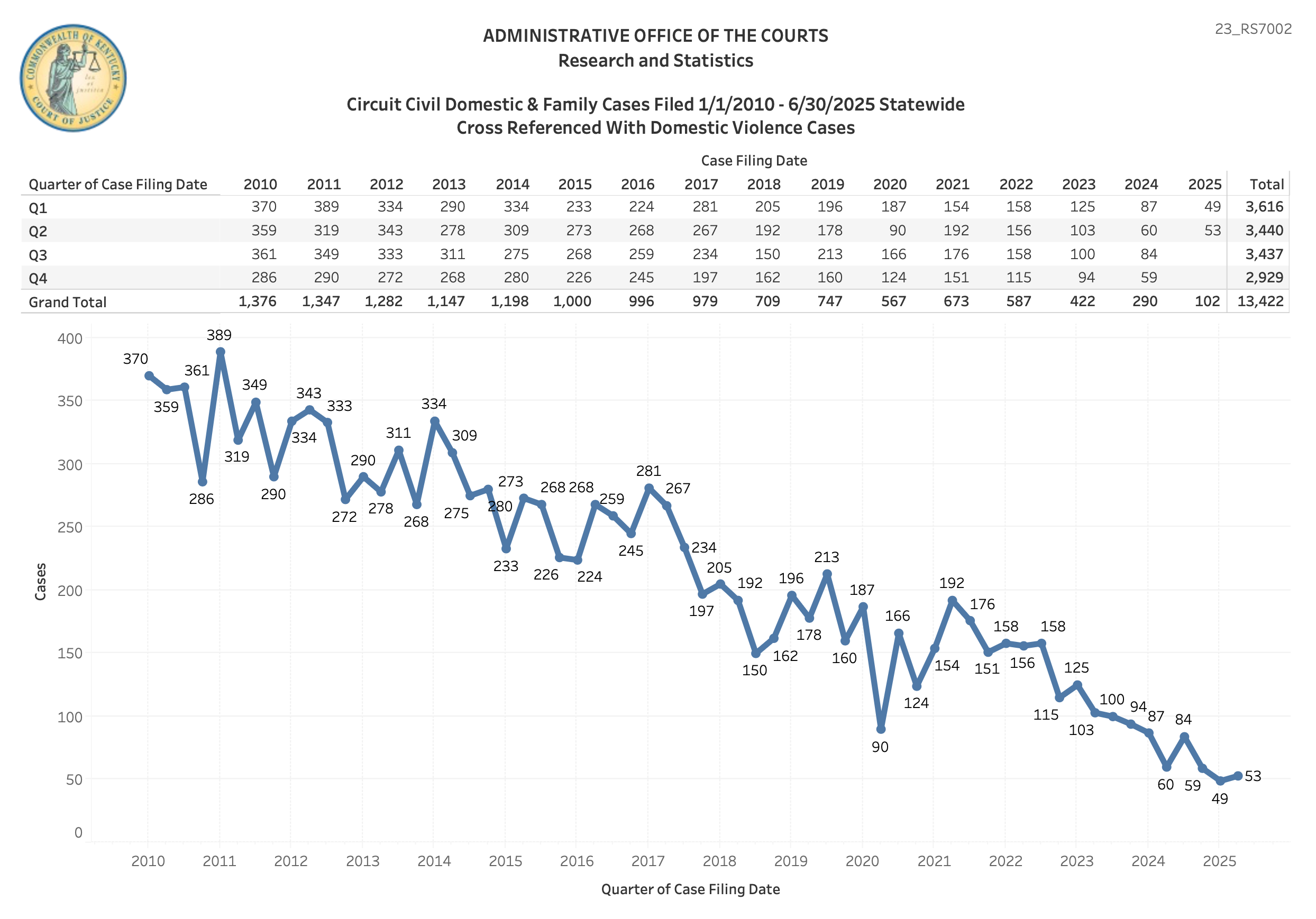
This chart is from Kentucky’s family court cases, cross-referenced with domestic violence cases 2010–2025.
Longtime Kentucky family court judge and Child Support Commission chair Lucinda Masterton told the state’s Courier Journal, “Since the [shared parenting] statute, we’ve had a lot fewer disagreements about parenting time.”
Similar trends are afoot in Arkansas. In 2021 that state enacted what is considered the strongest presumption of joint custody in the country, requiring clear and convincing evidence to deviate from 50/50 joint custody. In the three years since, divorce filings have dropped, the number of family court filings with orders of protections have dropped, along with other positive outcomes including paternity filings without support (mostly dads) increased, paternity filings with support (mostly moms) decreased.
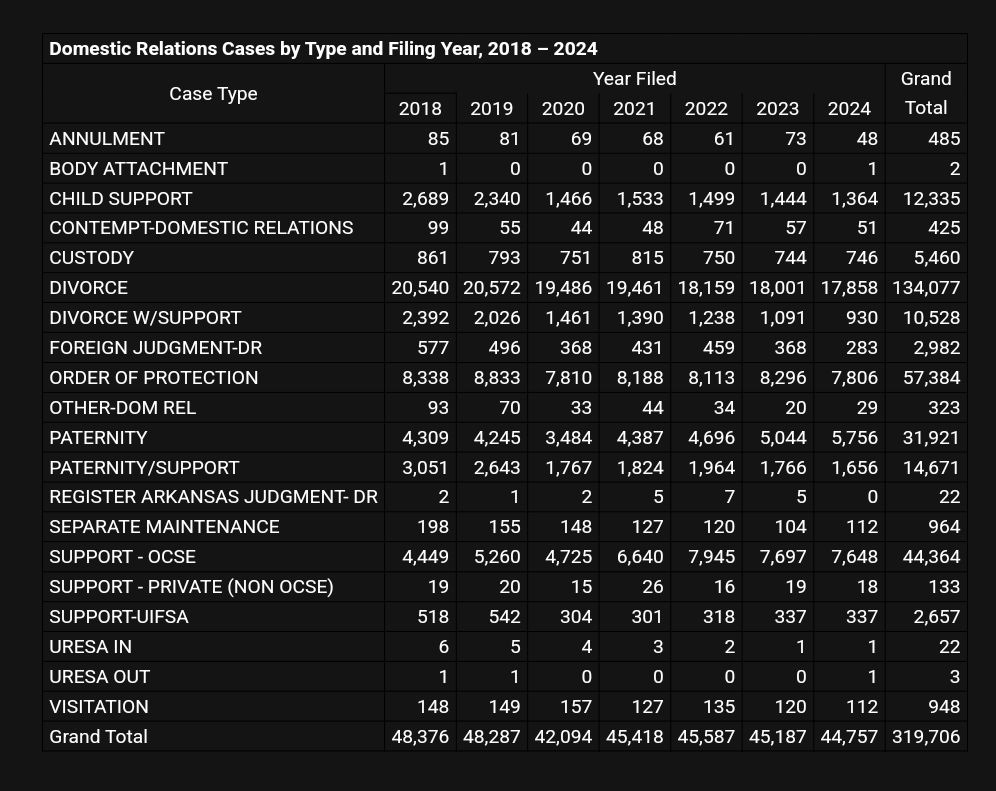
Source: Arkansas Advocates for Parental Equality
Female homicide rates and equal parenting presumptions
Researchers in Spain2 studied that country’s outcomes after equal parenting presumption laws were passed in 2009, after which the rate at which parents shared time 50/50 after divorce went up 400%, but rates of intimate partner violence in those regions declined significantly during that same period when compared with the other 13 regions of Spain where mostly mothers gained primary parenting time:
50% decrease in physical abuse
69% decrease in psychological abuse
Female homicides during marriage also decreased significantly in Spanish states with 50/50 parenting.
What Kentucky Family Court judge Mica Wood says about magistrates’ hesitancy about 50/50 presumptions — and what they say now:
50/50 laws help close pay gaps. Data from Spain, the United States and Sweden
One more report of evidence that equal parenting laws correlate with lower intimate partner violence: in Arizona in 2010, a new statute required judges to order “maximum parenting time” to both parents, which was widely interpreted as 50/50 time, but also gave judges leeway to make exceptions—as do all passed and proposed equal parenting laws. Since then, researchers polled family court professionals (judges, lawyers, therapists, mediators) who overwhelmingly liked the law, said it was effective in mainstreaming 50/50 parenting schedules, and saw that it had a positive effect on children.3
These professionals reported that after the new policy was implemented, there was not more conflict between parents or increased litigation, though they did perceive a slight increase in allegations of domestic violence and child abuse—a half step above a neutral perception. There was no data on whether those allegations were substantiated. But again, these mostly pro-50/50 court professionals also saw overall less parental conflict after the law was in effect.
Those who study family law suggest that the uptick in Arizona domestic violence allegations could be attributable to false allegations in an effort to gain a legal upper hand in custody disputes where 50/50 is the presumption. There are also those who theorize that 50/50 presumptions clear courts of false claims and make room for courts to appropriately support actual abuse cases. The verdict is still out, though the 2018 paper on Arizona suggests that in the absence of more parent conflict, the increased abuse allegations are more likely of the false variety.
Child abuse rates and 50/50 laws
This seems to also be true when it comes to equal parenting and child violence. The National Parents Organization, the leading U.S. nonprofit advocating for equal parenting laws, assessed parenting guidelines in each of Ohio’s 88 counties for how likely they were to provide children with equal parenting time arrangements, giving them letter grades A through F. NPO then compared these ratings against substantiated incidents of mental, physical, and sexual child abuse.
Child abuse rates in counties that had an A or A- grade were half those with a D.

According to the report’s authors,
It could be that by reducing parental legal conflict over parenting time, courts are able to attend more closely to those cases that present significant risks of child maltreatment, stemming some of the harm to children. It could be, also, that lowering the conflict between the parents over parenting time reduces antagonism that spills over to the children. And, of course, part of the explanation could be that, where two parents are equally engaged in rearing their children, neither is as likely to feel overburdened and stressed out by child care responsibilities and both can serve as a watchful eye over the children’s well-being.
Text from a feminist friend this a.m.: "Good morning! Girl you’re doing important work. Outstanding read. It’s important we push back on factually phony stereotypes, to not only help protect our men and our boys but even women's perceptions of themselves."
The very first person I interviewed when I got WIBM up and running five years ago was Ann Silvers, author of Abuse of Men By Women. She mentioned the female-on-male punch at the end of Frozen as an example of media portraying positively women's violence against men. Since that time I have not heard another person call that out as problematic. Thank you for doing so and for including the clip.
Great job talking about the policy of mandatory arrest. Washington is one of the states with this policy (RCW 10.31.100 and 10.99.030). Our state's nonpartisan research institute did a study in 2022 that basically found no benefits to the policy. From time to time I ask around among legislators and advocacy organizations to see if there is interest in changing our mandatory arrest policy. So far I have not found interest, despite what that 2022 study showed.